Storm and Flash Flood Cleanup in Brooksville, FL
Brooksville's hills send heavy rain racing downhill, and summer storms and tropical systems can push that water into homes. The response team extracts it and handles it as contaminated.
(888) 621-2041Water still spreading? Get extraction started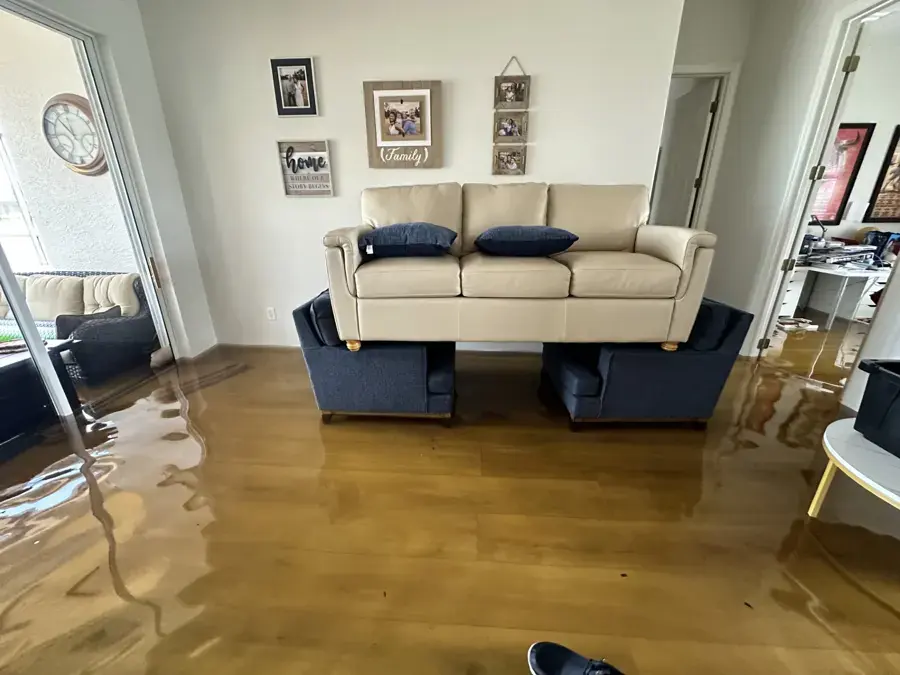
What to do right now about storm and flash flood cleanup in Brooksville
Most of Florida is flat. Brooksville is not. The Brooksville Ridge puts real hills under the town, so a summer downpour runs off roofs, driveways and yards and heads downhill fast. Homes at the bottom of a slope, beside a drainage swale or below a road take the water.
Stay out of deep water
Moving water and wet outlets are dangerous; wait until it recedes.
Cut power safely
Have power shut off at the meter or panel if the panel is dry and reachable.
Document the water line
Photograph the high-water mark on walls before anything is removed.
Move valuables up
Lift what you can off the floor, then call for extraction.
How storm and flash flood cleanup is handled in Brooksville, FL
Walkthrough and moisture map
The tech who does the walkthrough finds the source of the storm and flash flood cleanup, then maps moisture with pinless meters and thermal imaging so the plan matches what is actually wet.
Stop the source and extract
The extraction crew pulls standing water with truck-mounted extraction and portable units, so the water leaves the building instead of moving into the next room.
Set the drying equipment
Air movers go in at the evaporation load of each room, with LGR dehumidifiers sized to Brooksville's humid air; wet framing and subfloor get dried in place where possible.
Daily readings to the drying goal
Crews record readings daily and pull equipment only when wet materials sit within 2 to 4 points of a dry reference in the same building, then hand over the drying logs.
What does storm and flash flood cleanup cost in Brooksville, FL?
In Brooksville, FL, storm and flash flood cleanup typically runs $2,500 to $15,000, depending on the depth of water, how many rooms were flooded, the flood cut height, and how much flooring, drywall and contents had to be removed and disposed of.
Shallow entry
- Water under doors, one area
- Carpet out, low flood cut
- Antimicrobial and drying
Several rooms
- Inches of water indoors
- Drywall, trim, flooring out
- Mud and debris removal
Whole floor
- Most of the house flooded
- Large-scale demolition
- Generators or desiccants
For a planning range on your own loss, try the water damage cost calculator. A firm number comes from the on-site walkthrough.
What floods Brooksville homes
- Afternoon thunderstorms from roughly June through September dump inches of rain in an hour.
- Tropical storms and hurricanes, June 1 to November 30, bring days of rain that saturate the ground.
- Runoff from higher ground overwhelms swales and pushes under doors and into crawlspaces.
- Low areas near lakes and the Withlacoochee hold water after long rain events.
Watch forecasts from the National Weather Service Tampa Bay office, which covers Hernando County, and the National Hurricane Center during hurricane season.
How floodwater is cleaned up
Water that came in from outside is Category 3. It carries soil, fertilizer, septic runoff and whatever else it crossed on the way. The extraction crew pulls standing water and mud, then the mitigation team removes porous materials the water touched: carpet and pad, the lower section of drywall (a flood cut), wet insulation and swollen trim. Hard surfaces and framing get cleaned and treated with an EPA-registered antimicrobial before drying begins.
Air movers and LGR dehumidifiers dry the exposed framing and slab, with readings taken daily until the drying goal is met. After a big regional storm, power outages and humidity make that drying harder, which is why generators and desiccant units sometimes come into play.
Flood coverage is its own policy
Rising surface water is usually excluded from standard homeowners policies and falls under flood insurance. Wind-driven rain through a damaged roof may be treated differently. Photos of the water line, a moisture map and daily drying logs help either way. For preparation and safety, Ready.gov flood guidance is a solid checklist.
How storm and flash flood cleanup gets done to standard
Rapid local response
Brooksville water damage pros answer day and night, and the response team treats standing water as urgent from the first call, nights and weekends included.
IICRC S500 drying standard
The drying team follows IICRC S500, the industry drying standard: moisture mapping first, then structural drying, not just surface drying.
Claim-ready documentation
Every loss gets a moisture map, daily readings and timestamped photos, the file an adjuster reads before deciding a claim.
Hernando County water experts
Pier-built frame homes, block homes on slabs, private wells, septic systems and summer storms: local experts know how water moves here.
Water damage restoration across Brooksville and Hernando County
The Brooksville restoration crew covers the city, the ZIP codes around it and the rural roads in between, day or night.
From the brick streets downtown to the well-and-septic homes out past Lake Lindsey, water damage pros serve all of Brooksville and the Hernando County communities around it.
Coverage includes ZIP codes 34601, 34602, 34603, 34604, 34605, 34613, 34614, plus Brookridge, Royal Highlands, Ridge Manor, Masaryktown and Nobleton.
Every community and ZIP coveredRelated water damage services in Brooksville
Storm and Flash Flood Cleanup questions from Brooksville homeowners
Q01Why is storm water treated as Category 3?
Water from outside picks up soil, lawn chemicals, animal waste and septic runoff. It is handled as contaminated, so porous materials it touched come out.
Q02What is a flood cut?
Drywall is cut in a straight line above the water mark, often 2 to 4 feet up, so wet insulation and framing behind it can be removed and dried.
Q03Can furniture be saved?
Solid wood and metal pieces can often be cleaned and dried. Upholstered furniture and mattresses soaked by floodwater usually cannot.
Q04Does homeowners insurance cover flooding?
Standard policies usually exclude rising surface water, which falls under flood insurance. Wind-driven rain may be treated differently. Coverage depends on your policy, so it is worth checking with your own insurer.
Q05How soon should cleanup start after a storm?
As soon as it is safe. Microbial growth can begin within 24 to 48 hours, and Brooksville humidity speeds it up.
Q06What if the power is out?
Drying equipment needs power, so crews may bring generators, and desiccant dehumidifiers help when heat and humidity are extreme.
Storm and Flash Flood Cleanup in Brooksville? Call now.
Every hour water sits, it wicks further into drywall, subfloor and framing. The Brooksville restoration team extracts, dries to the IICRC S500 standard and documents the loss for the claim.
(888) 621-2041Get the Hernando County drying crew moving